Sweeteners are one of those subjects where nutrition can become unnecessarily complicated. Depending on what you read online, artificial sweeteners are either a brilliant way to reduce sugar and calories, or they’re going to make you gain weight, destroy your gut health and possibly give you cancer. As usual, the reality is considerably less dramatic.
As a weight loss coach, I’m particularly interested in sweeteners from a practical point of view. Can they help someone lose weight? Can they make weight loss harder? And if swapping a sugary food or drink for something containing a sweetener helps someone consume fewer calories, is that a useful thing to do? I think it can be.
I once had a client who had got into a very strong habit of heading to the kitchen at around 9pm every night and snacking. Rather than initially trying to remove that habit completely, we gave it some structure. Every evening at 9pm, he had a Solero ice cream.
For clarity, a Solero isn’t actually an example of a food containing artificial sweeteners. It contains sugar and is around 100 calories. But it illustrates an important point about weight loss. Was eating an ice cream every evening the most nutritionally perfect thing he could have done? Probably not, I’d have some sweet fruit instead myself. But was it considerably better for his weight loss than eating four packets of crisps and two chocolate bars? Absolutely.
The same principle can apply to sweeteners. I have clients who occasionally use drinks such as Coke Zero or Sprite Zero when they really fancy something sweet, and I sometimes do it myself. I’m not suggesting that drinking litres of artificially sweetened fizzy drinks every day is the pinnacle of healthy nutrition. Water would clearly be a better everyday drink. But that’s not always the real choice.
If having a zero-calorie fizzy drink satisfies someone’s craving for something sweet and stops them eating three bags of Haribo, that’s a completely different comparison. This is where I think some of the discussion around sweeteners and weight loss goes wrong. We look at a food or drink in isolation instead of asking what it’s replacing.
What Are Sweeteners?
Sweeteners are ingredients that give foods and drinks a sweet taste while generally providing considerably fewer calories than sugar, or sometimes virtually none. You’ll find them in everything from diet soft drinks and yoghurts to chewing gum, protein products, desserts and tabletop sugar substitutes.
There are lots of different types, and the term “artificial sweeteners” isn’t technically accurate for all of them. Some of the sweeteners you’re likely to come across include:
- Aspartame: Commonly used in sugar-free soft drinks and other low-calorie products.
- Acesulfame K: Often combined with other sweeteners in drinks and foods.
- Sucralose: A very sweet sugar substitute commonly found in reduced-sugar foods and drinks.
- Saccharin: One of the older artificial sweeteners.
- Steviol glycosides (stevia): Derived from the stevia plant and often marketed as a more “natural” alternative.
- Erythritol: A type of polyol or sugar alcohol that provides fewer calories than ordinary sugar.
- Xylitol: Another polyol, commonly found in sugar-free chewing gum and some foods.
- Sorbitol: A polyol used in various sugar-free products.
It’s worth knowing that polyols such as erythritol, xylitol and sorbitol aren’t quite the same thing as the non-sugar sweeteners found in many diet drinks. Some also contain calories, although generally fewer than sugar.
Do Sweeteners Help With Weight Loss?
Sweeteners don’t cause weight loss in the sense that eating or drinking them somehow makes your body burn more fat. Their potential benefit is much simpler. They can help you reduce your calorie intake when they replace something containing more calories.
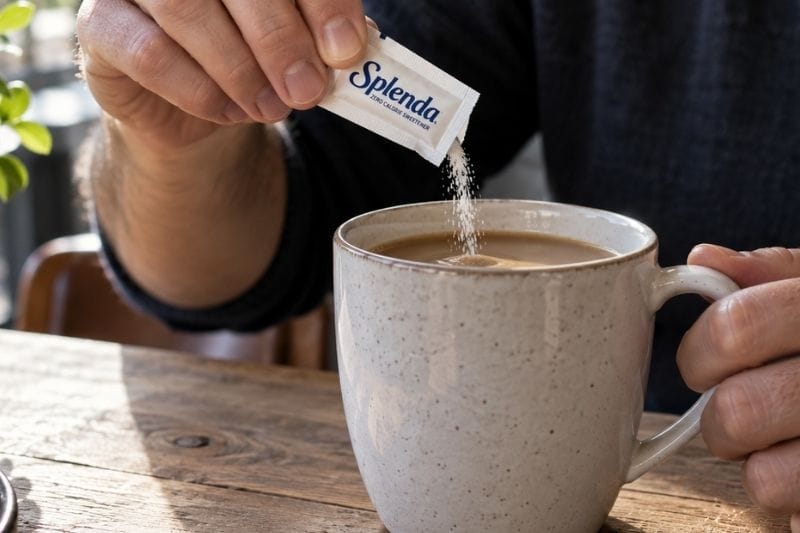
Imagine someone normally drinks two cans of full-sugar fizzy drink every day and then switches them for the zero-sugar version. Assuming they don’t compensate by consuming those calories somewhere else, they’ve reduced their daily calorie intake without actually giving anything up. The same could apply to replacing sugar in tea or coffee, or choosing a lower-calorie product containing sweeteners instead of a much higher-calorie alternative.
Ultimately, fat loss still requires an energy deficit. If you’re consistently consuming more energy than your body needs, putting sweetener in your coffee isn’t going to magically undo that. But if using sweeteners makes creating that calorie deficit easier, they can potentially be a useful weight loss tool.
There is some evidence to support this too. In 2025, the UK’s Scientific Advisory Committee on Nutrition (SACN) reviewed the World Health Organization’s guidance on non-sugar sweeteners. SACN concluded that replacing free sugars with non-sugar sweeteners reduces energy intake and body weight.
That’s an important distinction. Sweeteners don’t appear to be some secret weight loss ingredient, but replacing sugar with them can reduce calorie intake, and that can help with weight management.
Do Artificial Sweeteners Cause Weight Gain?
This is probably one of the biggest concerns people have about artificial sweeteners. You’ll certainly find research showing an association between consuming more artificial sweeteners and having a higher body weight, but there’s a problem. An association doesn’t necessarily tell us which thing caused the other.
For example, imagine we discovered that people attending Weight Watchers tend to weigh more than people who don’t attend Weight Watchers. It would be fairly ridiculous to conclude from that information alone that Weight Watchers makes people gain weight. People are more likely to attend because they’re already overweight or trying to lose weight.
Something similar can happen when studying diet drinks and sweeteners. People who are overweight, have previously gained weight or are actively trying to lose weight may be more likely to choose diet drinks and foods containing sweeteners in the first place. This is known as reverse causality.
When researchers actually intervene and replace sugar with non-sugar sweeteners in randomised trials, the results tend to go in the other direction, with a small reduction in calorie intake and body weight. So, no, the evidence doesn’t support the simple claim that drinking a Diet Coke somehow makes you gain weight. Of course, you can drink Diet Coke and gain weight. You can also drink water and gain weight. Your overall calorie intake still matters.
Can Artificial Sweeteners Prevent Or Stall Weight Loss?
Another common claim is that artificial sweeteners somehow prevent weight loss, slow your metabolism or make losing body fat impossible. Again, there’s no convincing reason to think that simply consuming an approved sweetener will stop you losing weight if you’re genuinely maintaining a calorie deficit.
There is also a popular theory that tasting something sweet automatically increases your appetite and makes you eat more afterwards. That sounds plausible, which is probably one reason it gets repeated so often, but something sounding biologically plausible doesn’t automatically mean it has a meaningful effect in the real world. The NHS states that there is no evidence that sweeteners stimulate appetite in humans.
That doesn’t mean everybody responds to every food or drink in exactly the same way. If you notice that having something very sweet leaves you wanting more sweet food afterwards, that’s useful information. Weight loss isn’t conducted in a laboratory and individual behaviour matters.
For someone else, the exact opposite might happen. A can of zero-sugar fizzy drink after dinner might satisfy that desire for something sweet and stop them raiding the cupboard half an hour later. That’s why I wouldn’t have a blanket rule telling every weight loss client that they either should or shouldn’t use sweeteners.
What Are The Best Sweeteners For Weight Loss?
There isn’t a “best sweetener for weight loss”, and I’d be wary of anyone claiming that stevia, sucralose, aspartame or another particular sweetener somehow has special fat-burning properties. Calories in, calories out still matters. So, from a weight loss perspective, the more useful question is: what is the sweetener replacing?
If you’re replacing two teaspoons of sugar in several cups of tea or coffee each day with a low or no-calorie sweetener, that could gradually make a difference to your overall calorie intake. If you’re replacing a full-sugar fizzy drink with a zero-sugar version, the calorie saving can be much greater.
But if you’re simply adding lots of foods containing sweeteners to an already excessive calorie intake, they’re unlikely to do anything useful for your weight. Context matters far more than finding the supposedly perfect sweetener.
Are Natural Sweeteners Better For Weight Loss?
“Natural” is one of those words that sounds reassuring on a food label but doesn’t necessarily tell us very much about whether something will help you lose weight. Honey is natural. Maple syrup is natural. Agave syrup is natural. They’re also sources of sugar and calories.
That doesn’t make them bad foods, and you certainly don’t need to remove them from your diet if you’re trying to lose weight. But replacing ordinary sugar with honey isn’t a weight loss hack simply because honey sounds more natural.
Stevia is slightly different because steviol glycosides provide sweetness with little or no energy and are derived from a plant. But once again, I wouldn’t get too caught up trying to find the most natural sweetener. If weight loss is your goal, look at your overall diet and calorie intake rather than assuming “natural” automatically means better.
Are Artificial Sweeteners Bad For You?
This is where we need to separate two different questions. Can sweeteners be useful for reducing calories, and does that mean we should consume unlimited quantities of them? Those aren’t the same thing.
Sweeteners approved for use in Great Britain have to undergo safety assessments before they can be used in food and drink. Acceptable daily intake levels are also established to represent the amount that can be consumed daily over a lifetime without an appreciable health risk. That doesn’t mean I think everyone should consume as many sweeteners as possible.
Interestingly, SACN’s 2025 recommendations are fairly cautious. It recommends minimising the intake of non-sugar sweeteners overall, while also acknowledging that swapping sugar for sweeteners may help adults reduce sugar and energy intake in the short term. Its longer-term recommendation is essentially to reduce our reliance on both sugar and non-sugar sweeteners.
I think that’s a perfectly reasonable position. If you currently drink three full-sugar fizzy drinks every day, switching to the zero-sugar versions could be a very useful step. Eventually drinking more water and fewer sweet drinks altogether might be even better. Those two ideas don’t contradict each other.
Do Artificial Sweeteners Cause Cancer?
This is probably the scariest claim you’ll see about artificial sweeteners. Aspartame in particular received considerable attention after the International Agency for Research on Cancer classified it as “possibly carcinogenic to humans” in 2023.
The important word there is possibly. That classification is about whether something could potentially cause cancer under some circumstances. It doesn’t tell you the level of risk from consuming normal amounts. At the same time, the Joint FAO/WHO Expert Committee on Food Additives reviewed the evidence and maintained the existing acceptable daily intake for aspartame at of 40 mg/kg body weight (about 30 to 40 cans of coke zero per day, subject to your bodyweight, if my maths is correct).
The NHS position is straightforward. Sweeteners approved for use in the UK are considered safe, and it notes that Cancer Research UK says sweeteners do not cause cancer. So I certainly wouldn’t tell a weight loss client that they need to avoid a can of Coke Zero because it’s going to give them cancer. As with almost everything in nutrition, quantity and overall dietary pattern matter more than frightening headlines.
Do Artificial Sweeteners Affect Your Gut Health?
This is an interesting area of research, but it’s also one where I think social media has got a little ahead of the science. You’ll often see definitive claims that artificial sweeteners “destroy your gut microbiome”.
Research has suggested that some sweeteners may affect gut bacteria, but different sweeteners aren’t necessarily going to have identical effects, and we’re still learning what changes to the microbiome actually mean for long-term human health. That’s very different from having strong evidence that occasionally consuming a diet drink is damaging your gut.
If you’re interested in improving gut health, I’d put considerably more attention into the basics such as eating plenty of fibre, fruit, vegetables and a varied diet than worrying about the occasional artificially sweetened food or drink.
Do Artificial Sweeteners Affect Blood Sugar And Insulin?
One reason sweeteners are used instead of sugar is that they can provide sweetness without the same amount of carbohydrate and calories. You’ll sometimes hear claims that merely tasting something sweet causes such a significant insulin response that artificial sweeteners are effectively no better than consuming sugar. That’s an enormous oversimplification.
Most non-sugar sweeteners don’t raise blood glucose in the same way that sugar does because they contain little or no digestible carbohydrate. However, different sweeteners and sweetener-containing products aren’t all identical, so it’s worth looking at the whole food or drink rather than assuming that anything labelled sugar-free will have no effect on blood glucose.
Different sweeteners can have different effects and the food or drink they’re contained in also matters, but consuming something sweet doesn’t automatically mean you’ve consumed the equivalent of sugar. If you have diabetes or another medical condition affecting blood glucose, personalised advice from your medical team should obviously take priority over a general weight loss blog!
What Are The Side Effects Of Sweeteners?
Some people do experience side effects from particular sweeteners. Polyols such as sorbitol, xylitol and erythritol can cause digestive problems when consumed in larger amounts. You may notice bloating, wind or a laxative effect, particularly if you suddenly consume quite a lot of them. This is one reason you’ll sometimes see a warning on sugar-free sweets and similar products stating that excessive consumption may produce laxative effects.
Aspartame also needs to be avoided by people with phenylketonuria (PKU), a rare inherited condition, which is why foods containing aspartame carry a warning that they contain a source of phenylalanine. For most people, however, approved sweeteners consumed within a normal diet are considered safe in the UK.
So, Should You Use Sweeteners For Weight Loss?
You don’t need artificial sweeteners to lose weight, but you also don’t need to be frightened of them. My approach with clients is always to look at what actually helps that individual create a diet they can maintain.
If you don’t particularly like diet drinks and you’re perfectly happy drinking water, brilliant. I’m certainly not going to tell you to start drinking Coke Zero because you’ve decided to lose weight. But if you normally drink 500 calories a day in sugary drinks and changing to zero-sugar versions allows you to remove most of those calories without feeling deprived, that could be an incredibly easy win.
Likewise, if having something sweetened with a low-calorie sweetener occasionally helps satisfy a craving (and your overall diet is very healthy) and it stops you eating considerably more calories elsewhere, I don’t see a problem with using that strategically. The goal shouldn’t be to build your entire diet around ultra-processed “diet” products just because they’re low in calories. Most of what you eat should still come from nutritious foods that provide protein, fibre, vitamins, minerals and everything else your body needs.
But successful weight loss doesn’t require nutritional perfection. Sometimes the better choice isn’t the theoretically healthiest option. It’s the realistic option that helps you make a meaningful improvement to what you were doing before. And if a sweetener helps you do that, I think it can have a perfectly reasonable place in a weight loss diet.
Frequently Asked Questions About Sweeteners And Weight Loss
Do Sweeteners Cause Weight Gain?
There isn’t good evidence that consuming approved sweeteners directly causes weight gain. Some observational studies have found that people consuming more sweeteners have higher body weights, but this may partly be because people who are already overweight or trying to lose weight are more likely to choose diet products. When sugar is replaced with non-sugar sweeteners in controlled trials, calorie intake and body weight tend to decrease slightly.
Do Artificial Sweeteners Prevent Weight Loss?
Artificial sweeteners don’t appear to prevent fat loss when someone is maintaining an appropriate calorie deficit. They may actually make reducing calorie intake easier for some people when they replace sugar or higher-calorie foods and drinks.
What Are The Best Sweeteners For Weight Loss?
There isn’t one particular sweetener that is best for losing weight. Sweeteners don’t burn fat. Their main potential benefit is allowing you to enjoy something sweet while consuming fewer calories than you would from a sugar-containing alternative.
Are Natural Sweeteners Better For Weight Loss?
Not necessarily. Honey, maple syrup and agave may be described as natural sweeteners, but they still contain sugar and calories. Something being natural doesn’t automatically make it better for weight loss.
Are Artificial Sweeteners Bad For You?
Sweeteners approved for use in Great Britain have undergone safety assessments and are considered safe at permitted levels. UK guidance nevertheless recommends minimising non-sugar sweeteners over the longer term as part of a healthy diet, while recognising that replacing sugar with sweeteners can be useful for reducing sugar and calorie intake.
Do Artificial Sweeteners Cause Cancer?
Current UK guidance does not advise people to avoid approved sweeteners because they cause cancer. Aspartame has received particular attention, but food safety authorities continue to consider it safe when consumed within established acceptable daily intake levels.
Need Some Help With Your Weight Loss?
Successful weight loss isn’t about having a perfect diet or cutting out everything you enjoy. It’s about finding an approach that works for you, your lifestyle and the way you actually eat.
If you’ve been struggling to lose weight, or you’re fed up with losing it only to put it back on again, my online weight loss coaching provides ongoing support, accountability and practical advice to help you make changes you can actually maintain.
Find out more about my online weight loss coaching or book a free consultation to have a chat about how I can help.