Last month I wrote a blog about the Eatwell Plate Guide, which is the UK’s official guide to a balanced diet, and whether it is actually useful for weight loss and protein intake. I mentioned that I rarely use it as a weight loss coach or when training people because, in percentage terms, the protein portion on the plate is relatively small.
This week, the USA announced an updated food pyramid of its own – their version of the Eatwell Plate – and unsurprisingly it has triggered a lot of debate. Social media has been full of hot takes, headlines have focused heavily on protein, and many people are now wondering whether this changes what they should be eating, especially if weight loss is the goal.
So what is the new US food pyramid really saying, and does it change anything in practice?
What Is the Food Pyramid and Why Does It Keep Changing?
The food pyramid was created as a population-level public health tool. It was never designed to be a personalised eating plan or a step-by-step guide for fat loss. Its role is to give broad guidance that can be applied across schools, workplaces, and public health messaging.
It keeps changing because the food environment keeps changing. Ultra processed foods are far more common than they were decades ago, portion sizes are larger, and many people are less active. Public health guidance has to respond to how people actually live, not how they ideally should.
Nutrition science also evolves over time. Updates usually reflect shifts in emphasis rather than complete reversals. Unfortunately, each change tends to be interpreted as proof that nobody really knows what they are talking about, which only adds to confusion!
What Is the New US Food Pyramid?
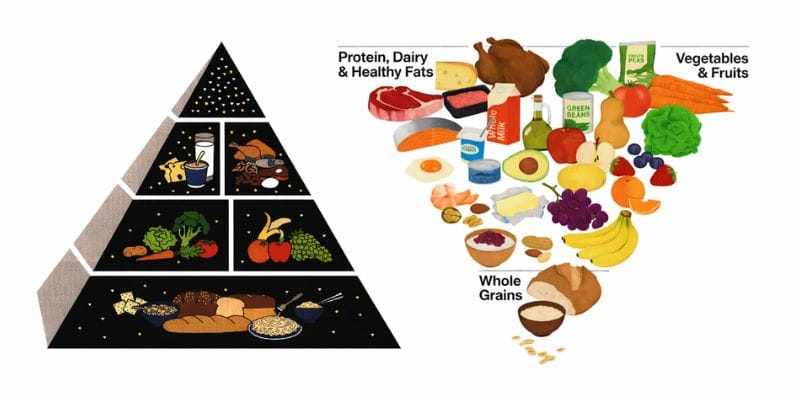
One of the reasons this update has attracted so much attention is that the new pyramid appears visually flipped upside down compared to older versions.
The new US food pyramid places greater emphasis on protein and whole foods, while drawing a clearer line around ultra processed foods and added sugars. Visually, it looks different to older pyramids, which has led many people to assume it represents a dramatic change in advice.
In reality, the fundamentals are familiar. The message is less about specific foods and more about food quality, balance, and choices that support better appetite control and long term health.
The challenge is that visuals simplify complex ideas. That simplicity is useful at population level, but it can easily be misread when people apply it to their own diet.
What Does the New US Food Pyramid Recommend?
Protein
Protein is more prominent in the new pyramid, reflecting growing awareness of its role in muscle mass, strength, recovery, and appetite control. Many people who struggle with weight loss undereat protein without realising it.
Some early reporting around the updated US guidance suggests a higher protein intake than the old minimum of 0.8 g per kilogram of body weight, with ranges closer to 1.2-1.6 g per kilogram being discussed, although this represents a shift in emphasis rather than a hard target for everyone.
This does not mean eating excessive amounts or turning every meal into a high-protein event. It means being more intentional about including a meaningful protein source at meals, whether from meat, fish, eggs, dairy, or plant-based foods.
Protein can make calorie control easier by improving satiety, but it still works within the context of total intake and overall habits.
Fruit and vegetables
Fruit and vegetables remain central, even if they are less headline grabbing. They provide fibre, volume, and micronutrients that support digestion, gut health, and appetite regulation.
One risk of the current debate is that protein dominates the conversation and fruit and vegetables quietly fall out of focus. In practice, diets that support sustainable weight loss usually include plenty of both.
Carbohydrates and whole grains
Carbohydrates are still included, with an emphasis on whole grain and minimally processed sources. Refined carbohydrates and foods high in added sugar are clearly discouraged.
This is not a message that carbs are bad. It is a reminder that quality and portion size matter far more than blanket rules. Cutting carbs entirely is rarely necessary and often makes diets harder to sustain.
Processed foods and added sugar
One of the strongest messages in the new guidance is reducing reliance on ultra processed foods. These foods tend to be high in calories, easy to overeat, and poor at supporting fullness.
This does not require perfection. It simply means being aware that diets built mainly around highly processed foods usually make weight loss more difficult.
Why Is the New US Food Pyramid Already Controversial?
Most of the controversy comes from interpretation rather than the guidance itself. People tend to project their existing beliefs onto simplified visuals.
Some interpret the protein emphasis as encouragement to eat large amounts of red meat. Others worry fibre and heart health have been pushed aside. In reality, the guidance still supports balance, but balance is difficult to capture in a single image.
Why this change is happening now
This update has arrived during a period of intense discussion in the US around public health, food systems, and personal responsibility. Public figures, including Robert F Kennedy Jr, have been outspoken about processed foods and chronic disease, which has amplified attention on the changes.
It is important to separate political debate from practical advice. Public health guidance takes years to assess properly, and meaningful outcomes cannot be judged in the short term.
Does the New US Food Pyramid Actually Help With Weight Loss?
A food pyramid does not cause weight loss. It does not create a calorie deficit, change habits, or manage stress, sleep, and routine.
What it can do is support better food choices. Encouraging adequate protein, reducing ultra processed foods, and improving food quality can make weight loss easier to sustain. That is very different from guaranteeing results.
People lose weight when they can stick to an intake that suits their body and lifestyle. A pyramid may help some people structure meals more sensibly, but it is not a replacement for consistency and accountability.
What Does the New US Food Pyramid Mean for People in the UK?
For people in the UK, this is not official guidance. The Eatwell Guide remains the UK’s framework for a balanced diet, and many of its principles overlap with the new US pyramid.
Both encourage whole foods, balanced meals, and limiting foods high in sugar and salt. The main difference is emphasis rather than direction.
For most people in the UK, this does not mean changing how they eat overnight. The fundamentals of weight loss remain the same.
Common Misunderstandings About the New Food Pyramid
Does this mean eating loads of meat?
No. The guidance is about adequate protein, not excess. Protein can come from many sources, and eating far more than you need will not speed up fat loss.
Are carbs now bad?
No. Whole food carbohydrate sources still have a place in a balanced diet. Problems usually come from portion size and highly processed options rather than carbs themselves. Personally – as I also run, lift and cycle – carbs are very much my friend as well as protein!
Is this better than calorie counting?
It is not a replacement for energy balance. It is a visual guide. Some people prefer structure through food choices, others prefer tracking. Neither works without consistency.
Should everyone follow this exactly?
No single guideline suits everyone. Health conditions, preferences, culture, budget, and lifestyle all matter. Good coaching adapts principles rather than enforcing rigid rules.
A Coach’s Perspective
While it’s far from perfect, the new US food pyramid does get some important things right. It nudges people towards real food, encourages a more sensible approach to protein, and draws clearer attention to how much of the modern diet is made up of ultra processed calories, all of which are positive shifts. Where it still falls short is in the areas that matter most for weight loss in the real world, portion sizes, habits, calorie intake, and day-to-day consistency, none of which can be meaningfully addressed by a single visual guide.
The basics still matter most.
Want Help Applying This to Real Life?
If you are trying to lose weight and feel overwhelmed by changing advice, you are not alone. Most people do not need stricter rules. They need clarity, structure, and support.
I work with busy people who want sustainable weight loss without extremes or confusion. If you want help building an approach that fits your routine, you can find out more about my online weight loss coaching.