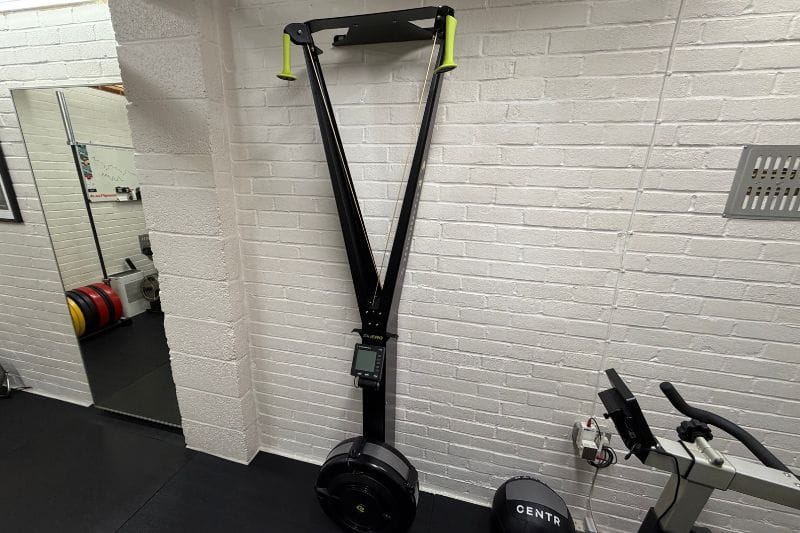
If you’re training for HYROX, there’s a good chance you’re going to spend quite a bit of time on the SkiErg. It’s the first functional station in a HYROX race, where you complete 1000 metres after your opening 1km run. However, the SkiErg isn’t unique to HYROX. It has become increasingly common in fitness racing, appearing in events including DEKA FIT, The Hybrid Games and TRYKA, as well as other hybrid race formats.
The exact distances and formats vary. The Hybrid Games, for example, currently includes a 1000m SkiErg, while TRYKA also uses a 1000m SkiErg as its first functional station. The principles in this article therefore apply more widely, although I’m going to concentrate predominantly on HYROX.
I’m particularly interested in improving SkiErg performance for two reasons. Firstly, I’m an official HYROX Performance Coach, so I’m always looking at how I can help my clients improve their performance across every part of a HYROX race. Secondly, I’ve got my own HYROX relay coming up at the ExCeL in London in December, and I’m first out on the SkiErg. I want to make sure I put down the best time I can for my team, so I’m currently working on honing my own technique and performance even further too.
The important thing to remember with HYROX is that being good at the SkiErg isn’t simply about producing the fastest possible 1000m time. You’re doing it at the beginning of a much longer event. Once you’ve finished skiing, you still have another 7km of running and seven functional stations ahead of you.
That means we need to think about technique, pacing and efficiency, rather than simply pulling as hard as possible.
TL;DR BloG Summary
- The HYROX SkiErg is 1000m and comes immediately after the first 1km run, so pacing matters. You still have almost the entire race ahead of you.
- Good SkiErg technique uses your lats, core and hips, rather than relying predominantly on your arms.
- I prefer to keep my feet mostly planted to avoid unnecessarily loading my calves, but experiment to find the technique that works best for you.
- HYROX SkiErgs are preset to damper setting 6, but you can change it. Higher isn’t automatically faster, so find the setting that gives you the best sustainable power.
- Recent race data puts average SkiErg times at around 4:39 for Men Open and 5:21 for Women Open, although your own sustainable race pace matters more than an average.
- Improve by combining technique work, shorter power intervals, longer sustained efforts and compromised running/SkiErg sessions.
- Most importantly, don’t chase a great SkiErg split at the expense of the rest of your race.
How Far Is the SkiErg in HYROX?
The SkiErg is the first functional station in a HYROX race. You complete your opening 1km run, followed by 1000m on the SkiErg, before heading back out for your second 1km run.
The SkiErg distance is 1000m inHYROX Singles, Doubles and Relay. If you’re competing in Singles or Relay (and you are doing the SkiErg as one of your stations within your Relay), you complete the entire distance yourself. In Doubles, the work can be shared between you and your partner should you wish.
Being the first station is significant when you’re deciding how hard to go. You should still be relatively fresh when you arrive at the SkiErg, which makes it very tempting to attack it. However, saving a few seconds here isn’t necessarily a great result if you’ve spent far too much energy doing it and then immediately lose that time when you start running again.
How to Use the SkiErg Properly for HYROX
One of the most common mistakes I see with the SkiErg is people relying too heavily on their arms. Your arms are obviously involved, but the SkiErg should be a much more complete movement using your lats, core and hips to help generate power.
Start tall with your hands high and initiate the pull strongly, bringing your upper body into the movement rather than trying to drag the handles down purely with your arms. As you pull, hinge through your hips (pushing your bum back, not squatting) and allow some movement through your knees. Finish the stroke strongly, then return smoothly to your starting position and establish a rhythm you can maintain.
A few useful things to concentrate on are:
- Start tall rather than already being folded forwards.
- Use your lats, core and hips alongside your arms.
- Allow some knee movement rather than keeping your legs completely rigid.
- Produce a strong but controlled pull.
- Return smoothly rather than rushing back to the top.
- Find a repeatable rhythm and stroke rate.
The recovery phase is important because you’re going to repeat this movement hundreds of times. If you’re fighting the machine during both parts of every stroke, you’re using energy that isn’t necessarily making you any faster.
I’d also be careful about trying to make every stroke as powerful as physically possible. A slightly lower output that you can repeat efficiently for the full distance may ultimately get you through 1000m faster than starting with enormous strokes and fading badly.
Should Your Heels Come Off the Ground on a SkiErg?
This is an interesting one because you’ll see plenty of very good athletes lifting their heels or even briefly lifting their feet as they reach the top of the SkiErg movement.
Under the current HYROX rules, lifting your feet is allowed, but both feet must remain on the SkiErg platform throughout the exercise. Your heels can also hang over the edge of the base, provided they don’t touch the floor.
Personally, I try to keep my feet mostly planted when I’m using the SkiErg. That’s not because I think everybody needs to keep their heels glued to the floor, but because I’m thinking about what I have to do afterwards.
If you’re aggressively coming up onto your toes with every stroke, you’re repeatedly using your calves. Multiply that across several minutes of skiing and that’s potentially quite a lot of additional calf work before you’ve even reached the second run.
For somebody doing a standalone SkiErg time trial or training for actual skiing, that may not matter. In HYROX, however, you still have another 7km of running ahead of you, so I don’t personally want to spend my first station doing hundreds for calf raises!
That doesn’t mean heel lift is bad technique. Some movement may feel completely natural and could help you generate power. I’d experiment and find what works for you rather than deliberately forcing either approach.
For me, the more useful question is not simply, “What technique gives me the fastest 1,000m SkiErg?” It’s, “What technique allows me to SkiErg quickly and efficiently while still letting me run well afterwards?”
What Damper Setting Should You Use for HYROX?

Damper settings cause a surprising amount of confusion, particularly because it’s very easy to assume that turning the number up makes the workout harder and therefore must somehow be better or quicker.
The damper is the small lever on the side of the SkiErg’s flywheel housing, numbered from 1 to 10, and it controls how much air enters the flywheel. A higher setting allows more air in, causing the flywheel to slow down more quickly between pulls and giving each stroke a heavier feel. A lower setting allows less air in, so the flywheel retains more speed and each stroke generally feels lighter and quicker.
The important distinction is that simply moving the damper to a higher number doesn’t automatically make the metres accumulate faster. The SkiErg monitor measures how quickly the flywheel slows between strokes, calculates the drag factor and uses this when calculating the work you’re producing. There’s no free speed simply from moving the lever.
However, a higher damper setting can allow you to produce more power per stroke. If you can maintain your stroke rate and that higher power output, you will cover the distance faster. The catch is that producing that additional force can place greater muscular demands on you, which may make it harder to sustain. A lower setting gives you a lighter stroke and generally makes it easier to maintain a higher stroke rate, potentially reducing the muscular demand of each individual pull.
That trade-off is particularly important in HYROX. Your goal isn’t necessarily to find the highest damper setting you can pull. It’s to find the setting that allows you to produce the best sustainable power without unnecessarily fatiguing yourself for the running and stations that follow.
In HYROX, the SkiErg is currently preset to damper setting 6 for all divisions. Importantly, you’re allowed to adjust it, and the current rules allow you to change the setting as many times as you want during the station.
That doesn’t mean 6 is automatically the best SkiErg damper setting for you. Your preferred setting can depend on your size, strength, technique and the stroke rate you naturally find most efficient. A powerful athlete may be comfortable producing a higher output with a heavier stroke, while somebody else may perform better using a lighter setting and faster turnover.
Experiment with different settings during training and look beyond the time on the screen. Pay attention to the pace and power you can sustain, how hard you’re working to produce it, which muscles are fatiguing and, particularly for HYROX, what happens when you start running afterwards.
Whatever you decide, I wouldn’t recommend turning up on race day and experimenting with a completely different setting because you’ve seen somebody fast using it on Instagram.
How Hard Should You Go on the SkiErg in HYROX?
Your fastest standalone 1000m SkiErg pace and your best HYROX SkiErg pace aren’t necessarily going to be the same.
You arrive at the first station after only 1km of running, so you’ll probably feel pretty good. It’s therefore easy to get carried away, hammer the SkiErg and feel fantastic about the number you’ve put on the screen. The problem becomes apparent when you head back out to run.
Saving 10 or 20 seconds (or so on) on the SkiErg isn’t much use if you’ve gone sufficiently hard that you lose considerably more than that during the next kilometre.
This is why I’d spend some time learning what a sustainable 1000m effort actually feels like. Pay attention to your average 500m split and stroke rate during training and start learning the relationship between your SkiErg pace, perceived effort and subsequent running.
You want to step off knowing you’ve worked, but you don’t want to feel as though you’ve just completed a standalone SkiErg race.
What Is the Average SkiErg Time in HYROX?

If you want to know how your SkiErg time compares with other HYROX competitors, recent race data gives us some useful benchmarks. Based on results from more than 40000 competitors at some of the biggest HYROX events, average SkiErg times are approximately (as at 28th Sept 2026):
- Men Open: 4:39
- Women Open: 5:21
- Men Pro: 4:15
- Women Pro: 4:48
- Men Doubles: 4:08
- Women Doubles: 4:51
- Mixed Doubles: 4:22
These are useful numbers for context, but I wouldn’t get too hung up on whether you’re above or below the average. Your age, division, overall fitness and experience will all affect your time, and your SkiErg split is only one small part of your overall HYROX performance.
Use the averages as a useful benchmark, but focus primarily on improving your own time while finding a pace you can sustain without compromising the rest of your race.
How to Get Faster at SkiErg
There isn’t one special workout that’s suddenly going to transform your SkiErg time. Getting better usually comes from improving a combination of technique, power, aerobic fitness and your ability to maintain good form as you become tired.
Improve Your SkiErg Technique
Before worrying too much about shaving seconds off your time, make sure you’re moving efficiently. If you’re wasting energy through poor technique, simply getting fitter isn’t necessarily addressing the underlying problem.
Filming yourself from the side can be useful. Look at whether you’re using your whole body, whether your movement is smooth and repeatable, and what starts changing when you become tired. You may find that your first 200m looks completely different to your final 200m.
Technique work doesn’t always need to be exhausting either. Spending some time skiing at an easier intensity while deliberately concentrating on movement and rhythm can be extremely useful.
Use Shorter SkiErg Intervals to Build Power
Not every SkiErg session needs to involve repeatedly completing the full race distance. Shorter intervals allow you to work at a higher output while maintaining good technique and can help develop your ability to produce more power.
One simple session might be:
8x250m SkiErg with 60 to 90 seconds recovery between rounds
Work hard during each interval while keeping your technique under control, then give yourself enough recovery to produce another quality effort. The objective isn’t to destroy yourself on the first few repetitions. Try to keep the quality and times relatively consistent across the session.
Build Your Ability to Hold SkiErg Pace
At the other end of the scale, you need to become comfortable maintaining an efficient output for longer periods.
For example:
4x500m SkiErg with 60 to 90 seconds recovery between rounds
Keep these controlled and consistent. Rather than smashing the first 500m and watching your pace disappear over the next three, see whether you can keep your splits reasonably close together.
As you improve, you can progress this by increasing the pace, adjusting the recovery or eventually using longer intervals.
Practise SkiErg With Running
This is where training becomes much more specific to HYROX and other fitness races.
For example:
3–6x800m run immediately followed by 500m SkiErg, then 60–90 seconds recovery between rounds
Being a good runner and being good on the SkiErg individually doesn’t automatically mean you’ll be good at combining them. The transition from running to the SkiErg is a skill in itself, and you need to understand how running affects your SkiErg pace and technique.
That’s why I like including compromised sessions where you use the SkiErg after running. They give you information that an isolated 1000m SkiErg time trial can’t.
Common HYROX SkiErg Mistakes
A few mistakes are particularly worth watching for when you’re training the SkiErg for HYROX:
- Going too hard too early: Remember that the SkiErg is station one. Your overall race matters more than your SkiErg split.
- Relying too heavily on your arms: Use your body efficiently rather than trying to muscle every stroke down with your arms.
- Assuming a higher damper setting is better: More resistance isn’t automatically faster. Find the setting that works for you.
- Sacrificing rhythm for power: Huge individual strokes aren’t particularly useful if you can’t sustain them.
- Doing unnecessary work with your calves: If you’re aggressively bouncing onto your toes with every stroke, consider whether it’s genuinely improving your performance.
- Only using the SkiErg when you’re fresh: Include some running and compromised work so you understand how the machine feels within a race.
- Ignoring what happens afterwards: A fantastic SkiErg split followed by a terrible run isn’t necessarily a good trade.
Getting Better at SkiErg: The Bigger Picture
The SkiErg is absolutely worth training if you’re preparing for HYROX, but don’t fall into the trap of treating each station as an isolated event. Your goal isn’t to set eight brilliant individual station PBs. Your goal is to put together the fastest overall race you can.
For the SkiErg, that means developing efficient technique, understanding which damper setting and stroke rate work for you, building the fitness to maintain your pace and learning how hard you can push without compromising your running.
This is also why I wouldn’t get too obsessed with copying somebody else’s technique, damper setting or target time. Test things during training, look at your own data and, most importantly, pay attention to what happens after you step off the machine.
Get that right and you won’t just become faster at the SkiErg. You’ll become better at using the SkiErg as part of a HYROX race.
HYROX SkiErg FAQs
What Is a Good SkiErg Time for HYROX?
There’s no single time I’d describe as “good” for everybody because it depends on factors including your sex, age, ability and overall race level. Your standalone 1000m PB also isn’t necessarily the number you should be chasing during HYROX.
A better benchmark is whether you can produce a strong, repeatable 1000m while remaining sufficiently controlled to run properly afterwards. As your training develops, you can monitor your 500m split and overall 1,000m time and look for improvements without needing to compare yourself with an arbitrary number.
What Is the Average HYROX SkiErg Time?
Average SkiErg times vary by division, age group and ability, so I’d be wary of using one overall average as your target. Elite athletes, experienced age-group competitors and somebody completing their first HYROX are obviously going to produce very different numbers.
If you want to benchmark yourself, compare your performance with athletes in your own division and age group, but use it as context rather than treating an average as the pace you have to achieve.
How Often Should You Train SkiErg for HYROX?
There’s no rule saying you need a certain number of dedicated SkiErg sessions every week. How often you train it should depend on your current ability, weaknesses and the rest of your programme.
If SkiErg is a weakness, some additional technique or interval work may be worthwhile. If you’re already strong on it, you may get more benefit from incorporating it into HYROX conditioning sessions and spending additional training time addressing areas where you can make bigger gains.
Remember that you also need to fit running, strength work and the other HYROX stations into your programme. More SkiErg isn’t automatically better if it simply adds fatigue without addressing something you actually need to improve.
What Can You Do Instead of SkiErg if Your Gym Doesn’t Have One?
There isn’t a perfect SkiErg alternative because the movement and feel of the machine are quite specific. Exercises such as straight-arm cable pulldowns, banded pulldowns and medicine ball slams can train some of the movement patterns and muscles involved, while rowing and other cardio machines can help develop the conditioning side.
If you’re actually preparing for a HYROX race, though, I’d strongly recommend getting access to a SkiErg periodically if you possibly can. You need some experience of the machine itself to understand your technique, damper setting, pacing and how it feels to run afterwards.
Looking for Help With Your HYROX or Fitness Race Training?
I’m an official HYROX Performance Coach and work with athletes preparing for HYROX at all levels, from their first event through to experienced competitors looking to improve their performance. I also coach people preparing for other fitness races, including The Hybrid Games, APEX Games, DEKA, TRYKA, GYMRACE and Deadly Dozen.
Whether you need help with your running, strength, SkiErg technique, race-specific conditioning or putting everything together into a structured training plan, I can build your training around you, your goals and the event you’re preparing for.
Find out more about my HYROX and fitness race coaching.