If you’ve looked at your HYROX results and wondered why there’s a line called Roxzone time eating up five, six or even eight minutes of your race, you’re not alone. The Roxzone is the area that links the running track to the eight workout stations, and every second you spend in it counts towards your finish time. It’s also where the water stations are, which is exactly why so many people lose more time there than they realise.
As an official HYROX Performance Coach, the Roxzone is one of the first things I look at when a client sends me their results. It’s often the easiest place to find time, because unlike your running or your sled push, getting faster here doesn’t necessarily require you to get any fitter. It’s mostly about knowing where you’re going, having a plan and not switching off between the run and the station.
In this blog I’ll explain what the Roxzone is, what your Roxzone time actually means, what a reasonable time looks like and how to manage your water so it doesn’t quietly add minutes to your race.
TL;DR Blog Summary
- The Roxzone is the transition area between the running track and the workout stations. You pass through it twice for every station (on the way in and on the way out), so 16 times in total.
- Your Roxzone time is all the time spent in the Roxzone across the whole race. It isn’t a separate or neutral timer, so it counts fully towards your finish time.
- Layouts vary by venue, so Roxzone times aren’t directly comparable between races. Estimates put the extra distance at roughly 700 to 800m.
- One analysis of 825 results put the field average at just over six minutes, with sub-70-minute finishers averaging around three and a half.
- Water is available at least once on every pass through the Roxzone, but you don’t need to stop at every station. Plan when you’ll drink and keep moving while you do it.
- Treat the Roxzone as part of your race, not a rest break. Review the course beforehand, know your lanes and practise moving from running into stations (and back out again) in training.
What Is the Roxzone in HYROX?
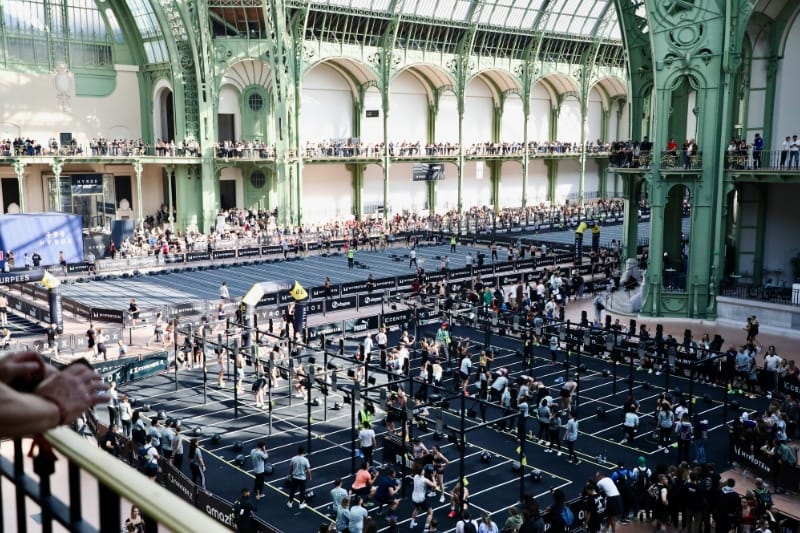
The Roxzone is the transition area of a HYROX race. After each 1km run you leave the running track, enter the Roxzone through an IN arch, make your way to the next workout station, complete it and then head back through the Roxzone and out of an OUT arch onto the track for your next run. Because you do this for all eight stations, you pass through the Roxzone 16 times during a race.
It’s essentially the hub of the whole venue. The stations are laid out within or alongside it, the water stations sit in it and it’s usually where most of the spectators can see you. That’s partly why it can feel a bit chaotic, particularly at your first race, with athletes coming in and going out in different directions and plenty of noise around you.
A few things are worth knowing before race day:
- The IN and OUT arches matter. Your timing chip is read as you pass through them, and running into the Roxzone through an OUT arch, or out of it through an IN arch, results in a 2-minute penalty. Stations also have their own IN and OUT arches, with the same penalty for using the wrong one.
- The layout changes from venue to venue. HYROX reserves the right to change the design of the course and the Roxzone, so the walk from the track to the SkiErg at one venue may be very different from another.
- Some stations take longer to reach than others. Depending on the layout, you may have a short hop to one station and a much longer route to another, which is another reason to look at the course map before the race.
The important thing to understand is that the Roxzone isn’t a pit lane where the clock stops. It’s part of the race, and how you move through it can make a real difference to your overall time.
What Does Roxzone Time Mean in HYROX?
Your Roxzone time is the total time you spent in the Roxzone across the whole race. On your results you’ll see a split for each of your eight runs and eight stations, and then a separate Roxzone figure. That figure is everything left over: walking or jogging from the track to each station, any time spent getting set up, drinking, recovering, looking for the right lane and heading back out again.
It doesn’t sit outside your race time, either. There’s no neutral period in HYROX, so if your Roxzone time is 6:30, that’s six and a half minutes that are already included in your finish time. It’s also why people are often surprised when they first see it. Your runs and stations might add up to a time you’re quite happy with, and then you realise there are several more minutes in there that you didn’t really think of as racing.
This is the bit I find most useful when reviewing a client’s race. A Roxzone time that looks high compared with their running and station splits usually tells me something, whether that’s walking more than they needed to, spending too long at water stations or simply not knowing where they were going.
How Far Is the Roxzone?
There isn’t one fixed Roxzone distance because it depends on the venue and how the course has been laid out. The running track and stations always add up to the same official distances, but the Roxzone is the space that joins them together, and that can vary considerably.
Estimates suggest the Roxzone adds somewhere in the region of 700 to 800m to your race once you add up all 16 passes, with each individual crossing typically being somewhere around 10 to 30m. Some venues will have a tight, compact Roxzone while others will have much longer routes between the track and the stations.
The practical point here is that your Roxzone time from one race isn’t directly comparable with another. If you raced at a venue with a big, sprawling Roxzone and then a much more compact one, your Roxzone time could improve without you having done anything differently. When you’re comparing races, it’s more useful to look at how your Roxzone time compares with your own running and station splits at that event.
What Is a Good Roxzone Time in HYROX?
As with most HYROX splits, there isn’t one number I’d describe as good for everybody. It depends on your level, your division and, more than anything, the venue. That said, I took a look online and found some useful stats from HYROX Utrecht, based on 825 complete results, which give a good idea of what’s typical. Grouped by finish time, the average total Roxzone times were:
- Sub 1:10 finishers: 3:41 (roughly 28 seconds per station)
- 1:10 to 1:20 finishers: 4:33
- 1:20 to 1:30 finishers: 5:19
- 1:30+ finishers: 6:58 (roughly 52 seconds per station)
The average across the whole field was 6:08, with men averaging 5:57 and women 6:34. Interestingly, faster athletes didn’t just have shorter Roxzone times, they also spent a smaller percentage of their race there, which tells you they were treating it as part of the race rather than a chance to recover.
These are useful for context, but because every venue’s layout is different, I wouldn’t get too hung up on how you compare. The most useful comparison is with yourself. Look at your Roxzone time across your races, ideally at the same venue, and think honestly about what you were doing in there. If you know you walked most of the transitions, stopped at every water station or wandered around looking for the sled, that’s the time you can find.The most useful comparison is with yourself. Look at your Roxzone time across your races, ideally at the same venue, and think honestly about what you were doing in there. If you know you walked most of the transitions, stopped at every water station or wandered around looking for the sled, that’s the time you can find.
Why You Lose So Much Time in the Roxzone
Most of the time lost in the Roxzone isn’t down to fitness. When I look at clients’ results, the same few things come up again and again, and very few of them are about how fast somebody can run.
- Switching off. The run finishes, you come through the arch and your brain decides that’s a good moment to relax. It feels like a transition rather than part of the race, so the pace drops to a walk without you really deciding to do it.
- Recovering in the wrong place. Taking a few extra breaths before the sled push feels sensible, but standing still in the Roxzone costs time without necessarily giving you much back. You can usually get a lot of that recovery while still moving.
- Not knowing where you’re going. If you haven’t looked at the layout, you can lose time hesitating, looking for the right lane or following the person in front of you to the wrong place.
- Faffing at stations. Adjusting the damper on the SkiErg, chalking up, sorting your grip or waiting for a judge’s instruction all add up if you haven’t thought about them beforehand.
- The water stations. Stopping for a full drink every time you pass, chatting while you do it or standing around finishing your cup can easily add a minute or more over the whole race.
None of these are huge on their own, but across 16 passes through the Roxzone it’s very easy for an extra 10 or 15 seconds here and there to become two or three minutes by the finish.
How to Manage Water in the Roxzone
This is the part of the Roxzone where I see the biggest difference between people who have a plan and people who don’t. Under the HYROX rules, water is available at least once on every pass through the Roxzone, and a sports drink may also be available. That’s a lot of opportunities to drink, and it’s very tempting to stop at every one of them because it’s there and because it feels like the sensible thing to do.
For most people, a HYROX race takes somewhere between an hour and an hour and 45 minutes. If you start the race well hydrated, you don’t need to drink at every water station and you certainly don’t need to stop for a full cup each time. Drinking too much can also leave you feeling sloshy, particularly on the runs and the burpee broad jumps.
What I’d recommend instead is deciding in advance roughly when you’ll drink. For many people that might be two to four planned drinks spread across the race, with a little more if it’s a hot venue or you know you sweat heavily. A few practical points:
- Start hydrated. Drink normally throughout the day before and the morning of the race so you’re not trying to play catch-up in the Roxzone.
- Take small amounts. A few mouthfuls is usually enough. You’re topping up, not rehydrating from scratch.
- Keep moving while you drink. Grab the cup and walk with it rather than standing at the table. You lose far less time and you’re still heading towards your station.
- Think about where it fits. Drinking just before a station like the SkiErg or rowing tends to be easier than drinking right before burpee broad jumps or wall balls, where a full stomach is the last thing you want.
- Bring your own if you need it. If you want a gel or your own drink, you must carry it from the start of the race. You can’t accept anything from anyone outside the official aid stations, and doing so is a 3-minute penalty.
- Drink it, don’t pour it. The fluids at aid stations are for drinking only. Pouring water over yourself to cool down carries a 2-minute penalty, as does dropping cups on the Roxzone floor rather than putting them in the bins.
If you want more detail on fuelling and hydration around the race, have a look at my HYROX nutrition plan.
How to Reduce Your Roxzone Time
The good news is that the Roxzone is probably the easiest place in a HYROX race to find time. Here’s what I’d focus on.
Walk the Course Before You Race
If you can, have a look at the course before your wave starts. Find the IN and OUT arches, work out the route to each station and notice which stations are close to the track and which are further away. Some venues publish a course map in advance, which is even better because you can look at it the night before. Knowing exactly where you’re going removes a surprising amount of hesitation.
Keep Running Into the Roxzone
Try to carry your running pace through the arch rather than stopping as soon as you cross it. You don’t need to sprint, but jogging to your station rather than walking can save you several seconds every time. Across 16 passes, that adds up quickly.
Recover While You’re Moving
If you need to bring your breathing down before a station, do it at a steady jog or brisk walk rather than standing still. You’ll often find that the first 10 or 15 seconds of a station are a perfectly good place to settle into a rhythm as well, rather than waiting until you feel completely ready before you start.
Have a Plan for Each Station
Know your SkiErg and rower damper settings, how you’ll set up on the sled, where you’ll put your hands and how you’ll start each station. The more decisions you’ve made in advance, the fewer seconds you lose making them in the race. My articles on pacing techniques for a faster HYROX and how to get better at SkiErg for HYROX go into this in more detail.
Get Out of the Station Quickly
It’s just as easy to lose time leaving a station as arriving at one. When you finish, get straight out through the correct OUT arch and back onto the track. Treat the first few metres of the Roxzone as the start of your next run rather than the end of your last station.
How to Train for the Roxzone
You can’t completely recreate a HYROX Roxzone in your local gym, but you can train the skills that matter.
The most useful thing is practising the transition itself. Running and then going straight into a station, or finishing a station and immediately starting to run, is a skill in its own right. That’s exactly what compromised running sessions are for. When I programme these for clients, I’ll often include a short walk or jog between the run and the station to mimic the Roxzone, rather than having them step straight off the treadmill and onto a machine.
A simple session might be:
4 to 6 rounds of 1km run, 20 to 30m jog to a station, 500m row or SkiErg, then straight back to running
The objective isn’t just the run or the station. Pay attention to what happens in between and practise keeping that bit moving. If you can, practise drinking a few mouthfuls from a cup while walking or jogging too. It sounds obvious, but plenty of people try it for the first time on race day.
Full HYROX simulations are also very useful a few weeks before a race. They’re the closest you’ll get to understanding how tired you’ll be by the later stations and how much discipline it takes to keep moving through the Roxzone when everything is starting to hurt. If you’re putting together your own programme, my guides on how to train for HYROX and the HYROX training plan are good places to start.
Common Roxzone Mistakes
A few mistakes are particularly worth avoiding:
- Treating it as a rest break: It’s part of the race and the clock is running the whole time.
- Not checking the layout: Hesitating or going the wrong way costs time, and using the wrong arch costs you a 2-minute penalty.
- Stopping at every water station: Plan your drinks and keep moving when you take them.
- Standing still to recover: Keep moving, even if it’s a walk, and let the start of the station do some of the settling for you.
- Not thinking about stations in advance: Damper settings, grip, sled set-up and how you’ll start should all be decided before race day.
- Comparing your Roxzone time across different venues: Layouts vary, so compare it with your own splits rather than your last race.
- Never practising transitions: If every run and station in training starts fresh, the Roxzone will always feel like a surprise.
The Roxzone: The Bigger Picture
The Roxzone doesn’t get anywhere near as much attention as the sled push or the wall balls, but it’s where a lot of people quietly give away minutes. The encouraging thing is that most of that time can be won back without any extra fitness at all. Know the layout, keep moving, have a plan for your water and your stations, and practise the transitions in training.
Get that right and your Roxzone time stops being the number that surprises you on your results and becomes one of the easiest places to improve your overall HYROX time.
HYROX Roxzone FAQs
Does Roxzone Time Count Towards Your HYROX Finish Time?
Yes. Your Roxzone time is part of your overall finish time, not something added on top or taken away. The results simply show it as its own split so you can see how much of your race was spent moving between the track and the stations.
Can You Walk in the Roxzone?
Yes, there’s no rule saying you have to run through the Roxzone, and plenty of people walk parts of it, particularly later in the race. Just remember that the clock is still running, so a brisk walk or steady jog will cost you far less time than strolling or standing still.
Is the Roxzone the Same at Every HYROX Venue?
No. The running and station distances are standardised, but the Roxzone layout depends on the venue and how the course has been designed. That’s why Roxzone times can vary quite a lot from one race to another, even for the same athlete.
Where Are the Water Stations in HYROX?
The water stations are in the Roxzone. Under the HYROX rules, water will be available at least once during, before or after each pass through the Roxzone, and a sports drink may also be provided. The exact positions depend on the venue, so check the course map or have a look before your wave starts.
Do You Have to Drink at Every Water Station?
No, and for most people I wouldn’t recommend it. If you arrive at the race well hydrated, a few planned drinks spread across the race is usually plenty. Take small amounts and keep moving while you drink rather than stopping at the table each time.
Looking for Help With Your HYROX Training?
I’m an official HYROX Performance Coach and work with athletes preparing for HYROX at all levels, from their first race through to experienced competitors looking to take time off their PB. I coach clients online wherever they’re based, and in person at my private studio in Farnborough, Hampshire.
Whether you need help with your running, your stations, your Roxzone strategy or putting everything together into a structured training plan, I can build your training around you, your goals and the race you’re preparing for.
Find out more about my HYROX coaching.